

Navigating the expanding world of research peptides presents a significant challenge for scientists in 2026. With over 100 therapeutic peptide products now available and countless research-grade options, selecting the right peptide for your experimental work requires careful evaluation of specificity, bioactivity, and practical application. This guide walks you through essential selection criteria, breakthrough peptides driving innovation across cancer, HIV, and cardiovascular research, and the AI tools revolutionizing peptide discovery to help you make informed decisions for your next study.
Table of Contents
- Criteria For Selecting Research Peptides In 2026
- Key Peptides Driving Breakthroughs In Disease Research
- Innovations Powered By AI And Novel Peptide Designs
- Comparing Top Research Peptides: Features And Applications
- Explore High-Purity Research Peptides At CK Peptides
- Frequently Asked Questions
Key takeaways
| Point | Details |
|---|---|
| Peptides enable targeted research | Research peptides serve diverse roles from cancer and HIV studies to cardiovascular and neurological investigations, offering high specificity for experimental precision. |
| AI accelerates peptide discovery | Deep learning and hybrid computational models streamline peptide optimization, reducing resource demands while uncovering novel candidates with improved bioactivity. |
| Selection demands multiple criteria | Choosing effective peptides requires balancing biological specificity, safety profiles, bioavailability, scalability, and alignment with experimental goals. |
| Market reflects growing innovation | The therapeutic peptide market includes over 100 products with expanding diversity, supporting breakthrough applications across biomedical research fields. |
| Exemplar peptides demonstrate potential | LA3IK for cancer-specific targeting and α-CGRP for cardioprotection illustrate how precision-designed peptides advance scientific understanding and therapeutic development. |
Criteria for selecting research peptides in 2026
Choosing the right research peptide starts with understanding what makes a candidate viable for your specific experimental goals. Biological specificity tops the priority list. You need peptides that interact precisely with target receptors or pathways while minimizing off-target effects that could confound results or introduce safety concerns.
Safety considerations extend beyond simple toxicity profiles. Assessing the actual impact of a specific product quality attribute on immunogenicity is difficult, making it essential to source peptides with documented purity and characterized immunogenic potential. Even minor impurities can trigger unexpected immune responses, yet gaps still exist in understanding impurities' role in peptide immunogenicity and control strategies, demanding extra vigilance in supplier selection.
Scalability matters whether you're running pilot studies or larger trials. Peptides that work beautifully in small-scale experiments but prove difficult to synthesize in larger quantities create reproducibility headaches. Bioavailability challenges similarly influence peptide efficacy, particularly for in vivo work where membrane permeability, metabolic stability, and tissue distribution determine whether your peptide reaches its target at effective concentrations.
Key evaluation factors include:
- Receptor binding affinity and selectivity for your target pathway
- Documented purity levels, typically >95% for research applications
- Stability profiles under storage and experimental conditions
- Delivery method compatibility with your study design
- Supplier reliability, including batch consistency and documentation
AI screening tools now streamline candidate selection by predicting binding characteristics, stability, and even membrane permeability before synthesis. These computational approaches save significant time and resources while expanding your accessible peptide design space.
For practical applications like tissue repair studies, researchers often turn to established options such as BPC-157 research applications that combine documented bioactivity with favorable safety profiles.
Pro Tip: Always request certificates of analysis from peptide suppliers showing purity verification via HPLC and mass spectrometry. This documentation proves essential for publication and reproducibility.
Key peptides driving breakthroughs in disease research
Several peptides exemplify how targeted molecular tools advance understanding across critical biomedical domains. These examples demonstrate the practical application of selection criteria in real research contexts.

LA3IK represents a breakthrough in cancer-specific targeting. This peptide effectively inhibits EGFR–ERBB2 heterodimerization in prostate cancer cells, reducing tumor progression through a mechanism that specifically disrupts cancer cell signaling while sparing normal tissue. The selectivity reduces collateral damage, a persistent challenge in cancer therapy development. LA3IK's design leverages structural insights into receptor dimerization, allowing researchers to study how blocking specific protein interactions translates to therapeutic benefit.
HIV research benefits enormously from peptide tools. Peptides have emerged as versatile tools in HIV research for several key reasons: they can mimic viral envelope proteins for vaccine development, block fusion mechanisms to prevent infection, and serve as probes to map immune responses. Peptide-based approaches enable scientists to dissect complex host-pathogen interactions at molecular resolution, revealing vulnerabilities in viral lifecycle stages.
Cardiovascular research employs peptides like α-CGRP with demonstrated protective effects. α-CGRP is a cardioprotective neuropeptide mitigating heart failure damage, offering researchers a tool to understand how endogenous protective mechanisms might be therapeutically harnessed. This peptide helps clarify signaling pathways activated during cardiac stress, information essential for developing interventions that preserve heart function after injury.
Notable research applications include:
- Oncology: Peptides targeting specific receptor heterodimerization for precision cancer studies
- Infectious disease: Fusion inhibitors and epitope mimics for vaccine development
- Cardiology: Neuropeptide analogs exploring protective signaling in heart failure
- Neuroscience: Blood-brain barrier permeable peptides for CNS drug delivery studies
For metabolic research, peptides like those covered in retatrutide peptide research demonstrate how multi-receptor targeting opens new investigational pathways.
Innovations powered by AI and novel peptide designs
Artificial intelligence fundamentally transforms how researchers discover, optimize, and validate peptide candidates. These computational advances compress timelines while improving success rates.
CreoPep exemplifies AI-driven peptide engineering. This framework employs deep learning with physics-based screening to design optimized conotoxin peptides, combining neural network predictions with molecular dynamics simulations. The hybrid approach captures both statistical patterns from training data and fundamental physical constraints, producing candidates with superior predicted binding and stability. Researchers using such tools can explore design spaces containing billions of theoretical sequences, identifying promising candidates that might never emerge from traditional trial-and-error synthesis.
Benchmarking efforts advance the field by clarifying which AI architectures perform best for specific peptide properties. Recent work demonstrates how systematic benchmarking of AI models predicts cyclic peptide permeability, a critical property for oral or cell-penetrating applications. Comparing diverse machine learning approaches reveals that ensemble methods combining multiple model types typically outperform single-architecture systems, providing actionable guidance for researchers building peptide discovery pipelines.
AI reduces resource burdens dramatically. Traditional peptide optimization requires synthesizing and testing hundreds of variants, consuming months and substantial budgets. Computational screening narrows candidate pools to high-probability successes before any laboratory work begins, cutting costs by 60-80% in many cases while accelerating project timelines.
Advanced design innovations include:
- Physics-informed neural networks combining data-driven learning with molecular mechanics
- Active learning loops that iteratively refine predictions using experimental feedback
- Generative models creating novel peptide scaffolds outside known sequence space
- Multi-objective optimization balancing competing properties like activity and stability
| AI Approach | Primary Advantage | Typical Application |
|---|---|---|
| Deep learning screening | Rapid candidate prioritization | Large library filtering |
| Physics-based modeling | Mechanistic insight | Binding site optimization |
| Hybrid methods | Balanced accuracy | Lead optimization |
| Generative design | Novel scaffold discovery | New therapeutic classes |
For researchers interested in how modern computational tools apply to specific peptides, explore the retatrutide peptide science guide for detailed mechanistic insights.
Pro Tip: When using AI predictions, always validate top candidates experimentally. Computational models excel at ranking and filtering but cannot yet replace empirical verification for properties like cell viability or complex tissue responses.
Comparing top research peptides: features and applications
Understanding how leading research peptides compare helps match tools to experimental needs. This analysis highlights key differentiators across bioactivity, safety, and practical application.
| Peptide | Primary Target | Key Bioactivity | Delivery Challenge | Safety Profile |
|---|---|---|---|---|
| LA3IK | EGFR-ERBB2 | Heterodimerization inhibition | Intracellular delivery | Cancer-specific, minimal off-target |
| α-CGRP | Cardiac tissue | Cardioprotective signaling | Systemic stability | Neuropeptide analog, well-tolerated |
| Retatrutide | GLP-1/GIP/glucagon receptors | Multi-hormone metabolic regulation | Subcutaneous injection | Extensive safety monitoring required |
| GHK-Cu | Tissue repair | Collagen synthesis promotion | Topical/local penetration | Copper sensitivity considerations |
| BPC-157 | Gastrointestinal/vascular | Angiogenesis and healing | Oral/injection stability | Limited human data, generally safe in animal models |
LA3IK demonstrates a favorable safety profile with cancer-specific actions sparing healthy tissue, making it ideal for oncology studies where selectivity prevents confounding toxicity. Its primary limitation involves achieving adequate intracellular concentrations, often requiring delivery vehicles or chemical modifications to enhance membrane permeability.
Cardiovascular researchers value α-CGRP for its endogenous protective mechanisms, though systemic stability demands careful handling and sometimes chemical stabilization through cyclization or unnatural amino acid incorporation. The peptide's well-characterized signaling pathways make mechanistic studies straightforward.
Metabolic research employs multi-target peptides like Retatrutide, which engages three distinct hormone receptors simultaneously. This complexity enables sophisticated studies of integrated metabolic regulation but necessitates careful dose optimization and comprehensive monitoring protocols.
The therapeutic peptide market includes over 100 products with high diversity, reflecting expanding applications across virtually every therapeutic area. This growth creates opportunities but also demands rigorous selection frameworks.
Selection considerations include:
- Experimental goals: Mechanism studies versus therapeutic development
- Dosing feasibility: Injection frequency, concentration requirements, formulation stability
- Tissue specificity: Systemic versus localized delivery needs
- Budget constraints: Synthesis costs, especially for modified or large peptides
- Regulatory context: Research-only versus clinical development pathway
For tissue repair and regeneration studies, GHK-Cu peptide research provides insights into copper-dependent healing mechanisms with straightforward application methods.
Explore high-purity research peptides at CK Peptides
Equipping your laboratory with quality peptide tools directly impacts experimental success. CK Peptides offers >99% purity research-grade peptides specifically designed for demanding scientific applications. Whether you're investigating cancer mechanisms, metabolic pathways, or tissue regeneration, reliable peptide sources eliminate variability that compromises reproducibility.
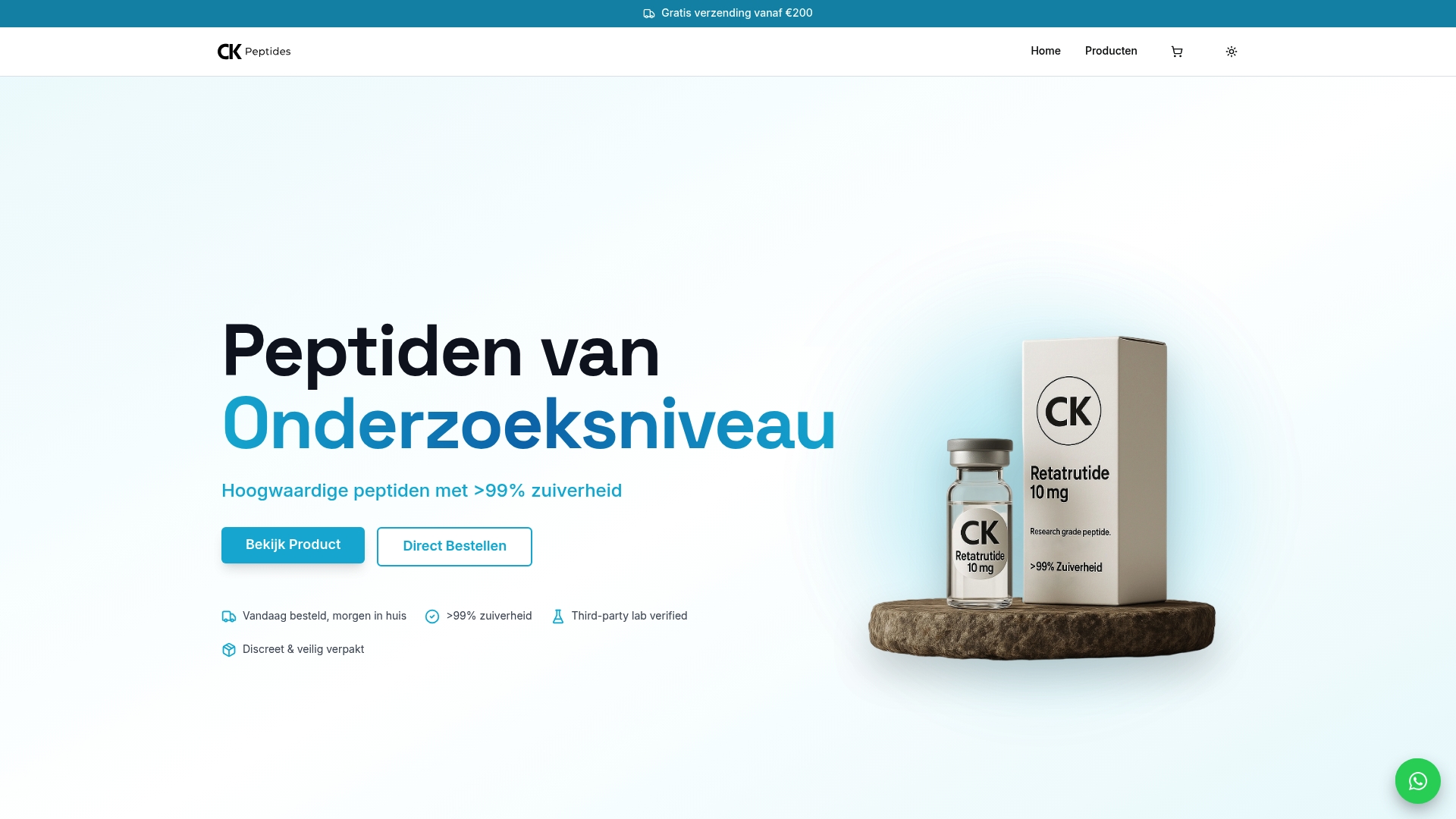
Our research grade peptide products span therapeutic areas from oncology to cardiology, each accompanied by comprehensive documentation including purity verification and handling guidelines. For laboratories initiating peptide-based research programs, our research starter kit simplifies acquisition with curated selections suited to common experimental designs.
Specific peptides like GHK-Cu demonstrate our commitment to supporting diverse research needs with consistent, high-quality materials. Fast European shipping from the Netherlands ensures your experimental timelines stay on track, while our technical support team provides guidance on handling, storage, and application protocols.
Frequently asked questions
What are the main advantages of using peptides in scientific research?
Peptides offer exceptional specificity for targeting biological pathways with minimal off-target effects, enabling cleaner mechanistic studies than small molecules. Their modular structure allows systematic optimization through amino acid substitutions or chemical modifications. Peptides effectively mimic natural signaling molecules, making them ideal tools for studying physiological processes and developing biomimetic therapeutics.
How do AI tools improve peptide discovery compared to traditional methods?
AI accelerates discovery by computationally screening billions of potential sequences before synthesis, identifying high-probability candidates that traditional trial-and-error would miss. Machine learning models predict binding affinity, stability, and permeability with increasing accuracy, cutting development timelines by months while reducing synthesis costs 60-80%. Hybrid approaches combining neural networks with physics-based modeling provide both speed and mechanistic insight.
What are the primary challenges limiting peptide use in research?
Bioavailability remains the foremost challenge, as many peptides struggle to cross cell membranes or resist enzymatic degradation in biological systems. Immunogenicity concerns require careful purity control, since even trace impurities can trigger immune responses that confound results. Cost and scalability issues affect larger studies, though improving synthesis technologies gradually address these limitations. Delivery method optimization often demands significant experimental investment.
Why is LA3IK particularly valuable for cancer research?
LA3IK specifically disrupts EGFR-ERBB2 heterodimerization, a signaling mechanism central to several cancer types, especially prostate cancer. Its selectivity for tumor cells over healthy tissue reduces confounding toxicity, allowing clearer assessment of therapeutic potential. The peptide's defined mechanism enables researchers to study how blocking specific protein interactions translates to downstream effects on cell proliferation, apoptosis, and tumor progression.
How should researchers evaluate peptide purity for experimental use?
Demand certificates of analysis showing HPLC and mass spectrometry verification, with purity typically >95% for most research applications and >99% for demanding studies. Examine impurity profiles, as specific contaminants like truncated sequences or aggregates affect results differently than simple dilution. Consider endotoxin testing for cell culture or in vivo work, since bacterial contamination causes inflammation independent of peptide activity. Request batch-to-batch consistency data for multi-phase projects.